Thursday, March 31, 2016

Poach Eggs, NOT Animals

In my post from two weeks ago I talked extensively about the exotic animal trade, which is often illegal and a part of wildlife trafficking. For today’s blog, I want to discuss a different issue – perhaps the most important one – that drives the illegal wildlife trade: Poaching. Specifically of rhinos and elephants.

As many of you probably know, elephants are hunted and killed illegally for their ivory tusks, and rhinos for their horns. Many people believe that ivory and rhino horns have special healing properties, while others use it to create jewelry and other ornaments. Whatever the intended use, the bottom line is that these two items are in demand now more than ever. And that’s a big problem. Here’s what you need to know.

RHINOS

Rhinos are some of the oldest beings alive today, whose ancestors date back tens of millions years. They have survived the changing of the world and have no predators – except humans.

There are five species of rhinos in the world: two African and three Asian. Out of the five, three of the species are classified as critically endangered on the International Union for Conservation of Nature (IUCN) Red List. They are the African Black Rhino (population 5,000+), the Asian Javan Rhino (population 63), and the Asian Sumatran Rhino (Population <100). The African White Rhino is near threatened (population 20,000) and the Asian Greater One-Horned Rhino (population 3,500) is vulnerable. However, there are three sub-species – the Javan Rhino in Viet Nam, the Northern White Rhino, and the Western Black Rhino – that are extinct. Since the beginning of the last century, all of the rhino populations – with one notable exception* – have declined by up to 98%.

The black rhino is probably in the most danger, as it has three horns which attracts many poachers. But why are the horns, which are made up of primarily keratin – the same thing that our hair and fingernails are made of – in such high demand? Well, there are many reasons and most of them are medicinal, as well as ancient. These reasons include beliefs that ground up rhino horn can detect poisons, purify water, and heal various illnesses and diseases. Others use the horn as a carving material, making various ornaments and decorations with the prized material. It’s now a symbol of wealth and of power.  

Photo of a hand holding a white rhino horn in South Africa.
White Rhino horn removed as a precautionary measure.
Credit: Brent Stirton
*The exception is considered a conservation miracle, as the African White Rhino population consisted of less than 100 individuals in the beginning of the 20th century, and through serious conservation efforts, has increased to over 20,000 today.

ELEPHANTS

Elephants are social creatures. They live in matriarchies and feel very acute emotions. Like rhinos, their only enemy is a human being.

Today, there are approximately 470,000 African elephants and somewhere between 40,000-50,000 Asian elephants left in the world. But thousands of elephants are killed every year, and the demand for ivory from the wealthy Asian countries such as China and Japan, as well as Europe and the United States is incredibly high. Ivory fetches a very steep price – averaging $1,000 per pound – and this high demand means high profits, which when coupled with lacking enforcement, creates a situation that puts the population of elephants is in grave danger.

Ivory is so popular because of its durability, the ease with which it can be carved, and the beautiful products it can produce such as jewelry, piano keys, and other decorative pieces. An article published in the Atlantic pointed out a comparison between diamonds and ivory: “Diamonds, like ivory, are a natural substance with little inherent value but prized social significance… But demand for ivory is something demand for diamonds is not: ancient.” Like the rhinoceros horn, it signifies wealth and power, both of which are important to too many people.  
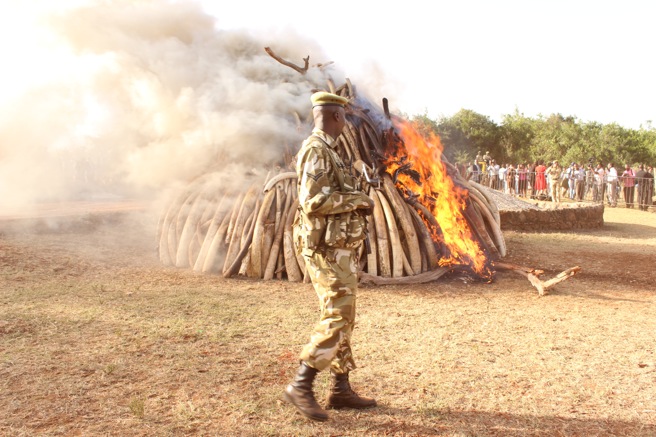
Burning illegal ivory.
Credit: Peter Chira, AWF
WHY POACH?

The answer is simple – money. Those who poach rhinos and elephants tend to be poor locals, whose greatest chance to make a living is by hunting and killing these animals. The consequences are not significant enough to deter many away from such a profitable endeavor. The price of ivory is high, and the price of a rhino horn is about 40 times as expensive, more than double the price of gold. It goes to show, the more rare the object, the higher the demand.

THE BIGGEST PROBLEM…

Besides the effect it has on the survival of these incredible animals, the profits incurred from poaching are known to go to terrorist organizations. There is a documentary called Explorer: Warlords of Ivory whose “mission is to expose how the ivory trade funds some of Africa’s most notorious militias and terrorist groups” by planting a GPS and satellite based tracking system inside a fake elephant tusk, and dropping it in the middle of the illegal ivory trade.

“Like blood diamonds from Sierra Leone or plundered minerals from Congo,” writes Jeffrey Gettlemen for the New York Times, “ivory, it seems, is the latest conflict resource in Africa, dragged out of remote battle zones, easily converted into cash and now fueling conflicts across the continent.” Groups like the Lord’s Resistance Army (Kony), al-Shahab and Darfur’s Janjaweed are hunting elephants and using the money they make from the ivory to buy weapons and finance their actions.

Source.
What the public needs to realize is that poaching is not just a matter of conservation. Too often people disregard environmental issues because they believe it does not concern them. However, it is vital that we bring attention to the fact that this issue affects people just as much as it affects the animals involved.

Buying illegal ivory or horns is perpetuating the suffering of poor animals; animals who are slaughtered and whose carcasses are poisoned to repel vultures that could give away a poacher’s location. It is perpetuating deaths of countless people – park rangers and law enforcement personnel that are doing everything they can to stop this illegal trade.

Unfortunately, our best is not enough at the moment. The trade is so expansive and our resources so lacking, will we ever be able to stop it?

Friday, March 18, 2016

Uncage the Elephant

The circus has been around since the year 1768, thanks to Englishman Philip Astley, who premiered the first modern circus show in London. He realized he could perform tricks on a horse, so long as it was galloping in a circle. So he drew up a ring and wowed the crowds by waving a sword around while standing on top of a horse. His performance was so popular, that by the time of his death, he had established 18 other circuses across Europe.

Print illustrating Astley's Royal Amphitheatre, date unknown
The first circus.
Source
The circus came to the United States in 1792, grew enormously in popularity over the next century, and in 1907 the five Ringling brothers bought the Barnum & Bailey circus company to create the most well-known circus organization in the world. They claim to be “the greatest show on Earth,” but at what cost?

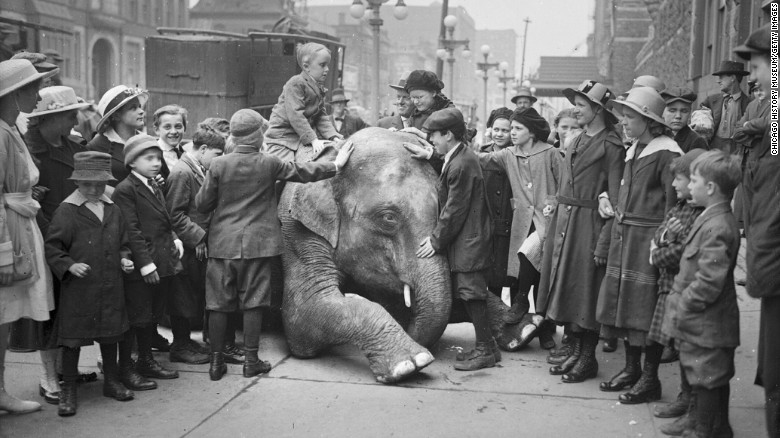
A blind child in Chicago sits on the back of a kneeling elephant from the Ringling Brothers Circus in April 1917. Ringling Bros. announced Thursday, March 5, that &lt;a href=&quot;http://money.cnn.com/2015/03/05/news/ringling-bros-circus-elephants/index.html&quot; target=&quot;_blank&quot;&gt;it will gradually reduce the use of elephants&lt;/a&gt; in its shows, and all will be retired by 2018.
Blind child sits on a Ringling elephant, 1917.
Source.
Animals have been a part of traditional circuses since the very beginning. Trained to ride bicycles, jump through hoops, balance on balls, and more, all for the crowd’s entertainment. They’re big money makers, because it’s always a thrill for children and adults alike to see these fantastic creatures performing fancy tricks. But while it’s relatively easy for people to train people to perform in the circus, how do people train animals?

 The answer?
CONDITIONAL TRAINING
Baby elephant "trained" with the help of bull hooks.
Source.


FEAR.
Trainer holds "training tools" to get tiger to perform.
Source
PUNISHMENT.
Source 

PAIN.
Monkey chained to bike.
Source.
That’s how.

Those are the standards for making animals perform. Animals perform in circuses because they are trained to be afraid of the consequences if they don’t. The only guideline that regulates how these animals are treated is the Animal Welfare Act, which was signed into law in 1966 and “is the only Federal law in the United States that regulates the treatment of animals in research, exhibition, transport, and by dealers.” However, this act still allows circus trainers the use of bull hooks, whips, and electrical shock prods, among other devices. The Animal Welfare Act, although it exists, does not have the teeth necessary to truly regulate the way circus animals are treated.

So circus animals spend around 96% of their lives in chains or in cages, being used and abused. Elephants, who roam for tens of miles each day in the wild, spend most of their time outside of training chained up without room for movement. Sometimes they lack adequate access to food, water, and veterinary care  and develop infections from their poor living conditions. Big cats like lions and tigers live and travel in cages with barely enough room for them to turn around. Bears can be muzzled, their noses broken, or their paws burned to make them stand on two legs. Elephants are bred, and then the babies are taken prematurely from their mothers, tied up, and get rope burns from struggling against the ropes tying their legs together.

Just enough room to lay down in.
Source
This kind of confinement leads to damage to the animals’ psyches. They develop habits of pacing or swaying, repetitive movements that are a sign of serious distress. And such distress can make animals dangerous. There have been numerous attacks on people – trainers and pedestrians alike – by circus animals. In each case, an animal escaped or rebelled against their trainer, did serious harm, and then was re-captured and killed the following day.  

So is all of that pain and suffering worth the hour of entertainment it produces?

Many people do not think so and actively protest travelling animal circuses, trying to inform the public of the cruel training tactics and urging people to boycott. So whether or not it is in response to protesters like these that Ringling decided to retire its elephants two years early is not entirely clear. But yes, Ringling will retire all of their travelling elephants in May of this year. The retired elephants will go to Ringling’s Center for Elephant Conservation in central Florida where they will no longer have to perform, but will continue to be bred and used for cancer research and eventually be displayed to the public as a tourist attraction.

But even though the elephant acts are going, there still remains the question of every other wild animal used in circus performances. Many countries do ban the use of animals in performances, including Mexico, but they raise the question of what to do with the animals once they are no longer “employed.” It is expensive to take care of an animal such as a bear or a tiger, so these animals can wind up being killed or sold to unknown buyers, causing more problems. So if the rest of the animals are removed from travelling circuses in the United States, will the circus create conservatories for them like they did for the elephants? However, we have yet to get to that point. Circuses do not plan to get rid of all of their animals any time soon, so that is a problem for another time.

Here's the Hideous Goat Creature Ringling Bros. Claimed Was a Unicorn in 1985
What polar bear willingly jumps through fire?
Source.
For now, animal rights activists continue to protest using animals as entertainment, and for good reason. The animals are not living the lives they were born to live. Performing in a circus goes against their every natural instinct, and they suffer. So next time someone you know wants to go to the circus, consider Cirque du Soleil.


*****
A great, though rather long piece detailing the treatment and training of elephants in the circus. 

Relating back to the last CI blog about illegal wildlife smuggling... a good question to ask is, how do circuses obtain the tigers that perform in their shows, if they're endangered? Once again, there is most likely a lack of enforcement of the Endangered Species Act.