The
circus has been around since the year 1768, thanks to Englishman Philip Astley,
who premiered
the first modern circus show in London. He realized he could perform tricks
on a horse, so long as it was galloping in a circle. So he drew up a ring and
wowed the crowds by waving a sword around while standing on top of a horse. His
performance was so popular, that by the time of his death, he had established
18 other circuses across Europe.
 |
| The first circus. Source |
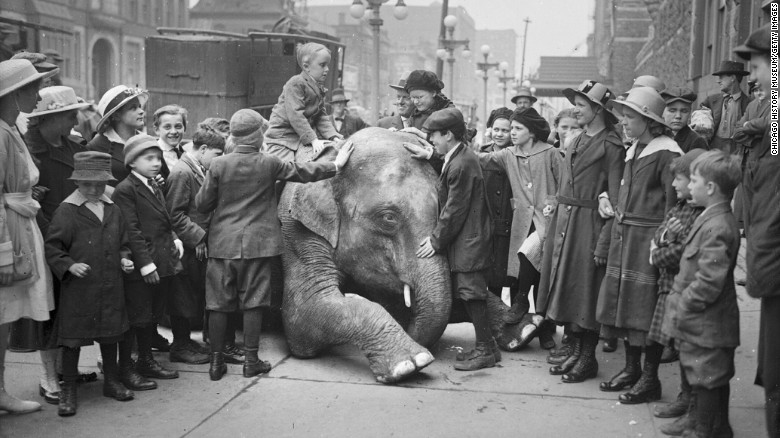 |
| Blind child sits on a Ringling elephant, 1917. Source. |
Animals have been a part of traditional circuses since the very beginning. Trained to ride bicycles, jump through hoops, balance on balls, and more, all for the crowd’s entertainment. They’re big money makers, because it’s always a thrill for children and adults alike to see these fantastic creatures performing fancy tricks. But while it’s relatively easy for people to train people to perform in the circus, how do people train animals?
The answer?
CONDITIONAL TRAINING
 |
| Baby elephant "trained" with the help of bull hooks. Source.
FEAR.
|
 |
| Trainer holds "training tools" to get tiger to perform. Source |
PUNISHMENT.
 |
| Source PAIN. |
 |
| Monkey chained to bike. Source. |
That’s how.
Those are the standards for making animals perform. Animals perform in circuses because they are trained to be afraid of the consequences if they don’t. The only guideline that regulates how these animals are treated is the Animal Welfare Act, which was signed into law in 1966 and “is the only Federal law in the United States that regulates the treatment of animals in research, exhibition, transport, and by dealers.” However, this act still allows circus trainers the use of bull hooks, whips, and electrical shock prods, among other devices. The Animal Welfare Act, although it exists, does not have the teeth necessary to truly regulate the way circus animals are treated.
So circus animals spend around 96% of their lives in chains or in cages, being used and abused. Elephants, who roam for tens of miles each day in the wild, spend most of their time outside of training chained up without room for movement. Sometimes they lack adequate access to food, water, and veterinary care and develop infections from their poor living conditions. Big cats like lions and tigers live and travel in cages with barely enough room for them to turn around. Bears can be muzzled, their noses broken, or their paws burned to make them stand on two legs. Elephants are bred, and then the babies are taken prematurely from their mothers, tied up, and get rope burns from struggling against the ropes tying their legs together.
 |
| Just enough room to lay down in. Source |
This kind of confinement leads to damage to the animals’ psyches. They develop habits of pacing or swaying, repetitive movements that are a sign of serious distress. And such distress can make animals dangerous. There have been numerous attacks on people – trainers and pedestrians alike – by circus animals. In each case, an animal escaped or rebelled against their trainer, did serious harm, and then was re-captured and killed the following day.
So is all of that pain and suffering worth the hour of entertainment it produces?
Many people do not think so and actively protest travelling animal circuses, trying to inform the public of the cruel training tactics and urging people to boycott. So whether or not it is in response to protesters like these that Ringling decided to retire its elephants two years early is not entirely clear. But yes, Ringling will retire all of their travelling elephants in May of this year. The retired elephants will go to Ringling’s Center for Elephant Conservation in central Florida where they will no longer have to perform, but will continue to be bred and used for cancer research and eventually be displayed to the public as a tourist attraction.
But even though the elephant acts are going, there still remains the question of every other wild animal used in circus performances. Many countries do ban the use of animals in performances, including Mexico, but they raise the question of what to do with the animals once they are no longer “employed.” It is expensive to take care of an animal such as a bear or a tiger, so these animals can wind up being killed or sold to unknown buyers, causing more problems. So if the rest of the animals are removed from travelling circuses in the United States, will the circus create conservatories for them like they did for the elephants? However, we have yet to get to that point. Circuses do not plan to get rid of all of their animals any time soon, so that is a problem for another time.
 |
| What polar bear willingly jumps through fire? Source. |
For
now, animal rights activists continue to protest using animals as
entertainment, and for good reason. The animals are not living the lives they
were born to live. Performing in a circus goes against their every natural
instinct, and they suffer. So next time someone you know wants to go to the
circus, consider Cirque du Soleil.
*****
A
great,
though rather long piece detailing the treatment and training of elephants in
the circus.
Relating back to the last CI blog about illegal wildlife smuggling... a good question to ask is, how do circuses obtain the tigers that perform in their shows, if they're endangered? Once again, there is most likely a lack of enforcement of the Endangered Species Act.

Best blog title award of this week goes to you, bar none. As I visited the zoo last week in Washington, D.C., I felt particularly close to the topic at hand. The elephants, fortunately, had a huge roaming area. Even so, the longer I stayed at the zoo, the longer I felt as though animal captivity was harming the animals not only at a physical level, but a psychological one as well. You made some great points in your post; keep it up!
ReplyDeleteI've always been against circuses but your post just confirmed my position even more. The use of animals for entertainment is pointless, and to abuse them while forcing them to perform is even worse. To me the most "entertaining" way to see animals is in the wild where they belong. Really great and informative post.
ReplyDeleteThis was a really informative post. I knew that conditions for circus animals were less than ideal, but I did not realize the harsh methods trainers use to teach the animals to perform tricks.
ReplyDeleteI loved this post! I learned a lot and it made me really question the circus. I knew there were issues but not to this extent. I'm not sure what the solution is but it's something that should be talked about.
ReplyDeleteI have never been to a circus, but I did know about the cruel animal treatment that is involved in them, that is mostly why I have never attended one. I think we need to take a step back and realize that animals aren't toys, and they should not be treated in ways that turns them into an entertainment device. It's important to support the movements to help animals remain in their natural habitat. Great post, Natalia!
ReplyDeleteJust like the food we eat, the animals lways are getting fed unhyealhtly crops or food. They are also taken away from their homes just to get killed later on in their life. FInally, the way how they are killed is just as psetting as the way how you described the circus act. It is as if people do not care about the animals anymore. It sucks that people are still informed, but CONTINUE to make the same decisions. That is why their haven't been any improvement on increasing the conditions for these animals since we are purely entertained by these animals. Plus, people make money off of it. So, that is why it is extremely hard to make a difference or gains with your topic. But amazing post! Can't wait for the next one!
ReplyDeleteI loved your blog post. I have been aware of the horribly cruel treatment of circus animals for a long time now and have never been to a circus. I was very interested in learning that circus performances are banned in Mexico, now we need more strict laws in the U.S. Relating to performance animals, Sea World has recently announced that it is ending its breeding progam which I think is great progress in the right direction.
ReplyDeleteI have been following this issue for quite sometime. I was a lover of the circus when I was little. My parent's never exposed me to the dark side of it. I only found out about all the cruelty the animals were subject to when I was little. It is a struggle to ban this cruelty because the circus is an ingrained business in the world's culture.
ReplyDelete